

Edge banding
Edge banding 0.5 or 2 mm — where each one goes
Thin banding on the edges nobody sees, thick where things get knocked. The difference in price per metre and per kitchen.
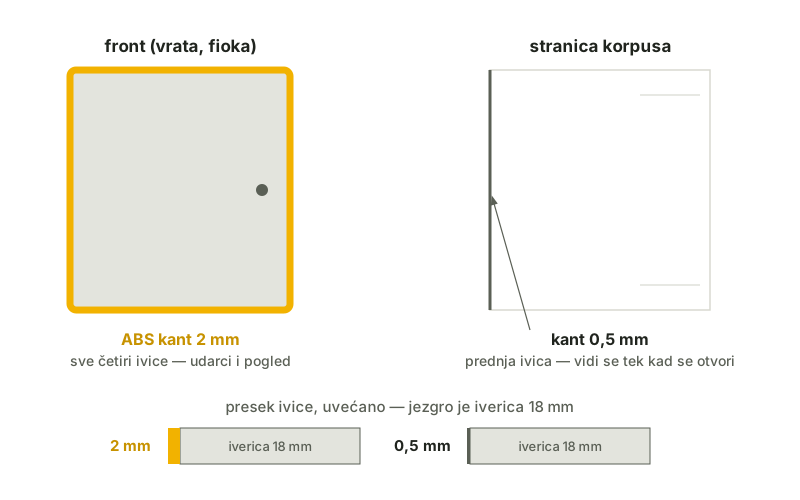
Thick 2 mm edge banding goes on the fronts and on the edges that are seen and take knocks. Thin 0.5 mm banding goes on the carcass edges. The rule fits into one sentence, and on a kitchen quote it makes a difference measured in tens of metres of banding — which is why this is the first thing to check when you are comparing two carpenters.
If you want to see how much banding your own kitchen carries, the planner adds it up metre by metre, edge by edge — free of charge.
What edge banding actually is
Edge banding is an ABS strip glued by machine onto the edge of the chipboard (univer). Inside, chipboard is wood chips and glue: an open edge soaks up moisture, swells and crumbles. The banding closes the edge off, protects it from water and steam, and takes the knocks instead of the board. Without edge banding, a kitchen around the sink and the dishwasher starts falling apart from the first winter.
Where 2 mm edge banding goes
On everything that is seen and everything that gets knocked:
- all four edges of every front — doors, drawers, lift-up flaps
- the visible edges of end cabinets and open shelves
The front is the part that takes the punishment: hands, rings, the vacuum cleaner, children's toys. 2 mm banding has a rounded edge that absorbs a knock and springs back into shape — thin banding would crack in the same place. On top of that, 2 mm of banding reads from the side as a tidy, deliberate edge.
Where 0.5 mm is enough
On the carcass — side panels, bottoms, rails, shelves:
- the front edges of side panels and bottoms, the ones you only see once the door is open
- the edges of shelves
- the edges of dividers and rails
Nobody knocks those edges and almost nobody looks at them — the banding there does one job only: it seals the edge against moisture and air. For that, 0.5 mm is quite enough, and the difference in price per metre between thin and thick banding is serious once you multiply it by all the edges of one carcass.
How many metres, and how much money
An average base cabinet has a front, two side panels, a bottom, rails and a shelf — several metres of banding, in two thicknesses, add up on one single cabinet. On a kitchen of ten cabinets that comes to tens of metres: enough for the wrong choice of banding to show up on the price, and for the right choice to show up on the kitchen five years later.
That is why our planner does not estimate edge banding as a lump sum: every edge of every piece knows whether it carries 2 mm, 0.5 mm or nothing, and the cutting list adds up the real metres by thickness and decor. When you change the decor or the thickness of the banding, the price is recalculated — from the price list, not from an average.
The same logic holds for the bigger dimensions: before the sheets are cut, check that your walls have been measured properly — the measuring guide was written for exactly that, and for corner cabinets read where 500 mm disappears.
How to check a quote
- ask which banding goes on the fronts: the answer should be ABS 2 mm, on all four edges
- ask whether the inside edges are banded: 0.5 mm on the visible carcass edges is the sign of a tidy workshop
- ask whether the cutting list reduces the pieces by the thickness of the banding — if he does not know what you are talking about, that is your answer
Three questions, five minutes — and the quote tells you more about the carpenter than his catalogue does.
Frequently asked questions
What is the difference between 0.5 and 2 mm edge banding?
Thickness and job: 2 mm is for fronts and visible edges — it is rounded and takes the knocks; 0.5 mm is for carcass edges — it seals the chipboard against moisture. The price per metre differs seriously, so thick banding is not put where it does nothing.
Is the edge banding counted into the size of the piece?
Yes — the piece is cut smaller by the thickness of the banding, so that with the banding on it comes out at the exact size. A cutting list that does not do this hands back fronts wider than the opening.
Which is better: ABS edge banding or ironing it on?
For a kitchen — machine-glued ABS. Banding glued on with an iron holds until steam and damp arrive, and the kitchen is the dampest room with furniture in it in the whole flat.