

Installation advice
Confirmat screws and dowels: cabinet assembly
Combine locating dowels with Confirmat screws, check drilling on a sample and assemble a square cabinet. Benefits, limitations and dismantling considerations.
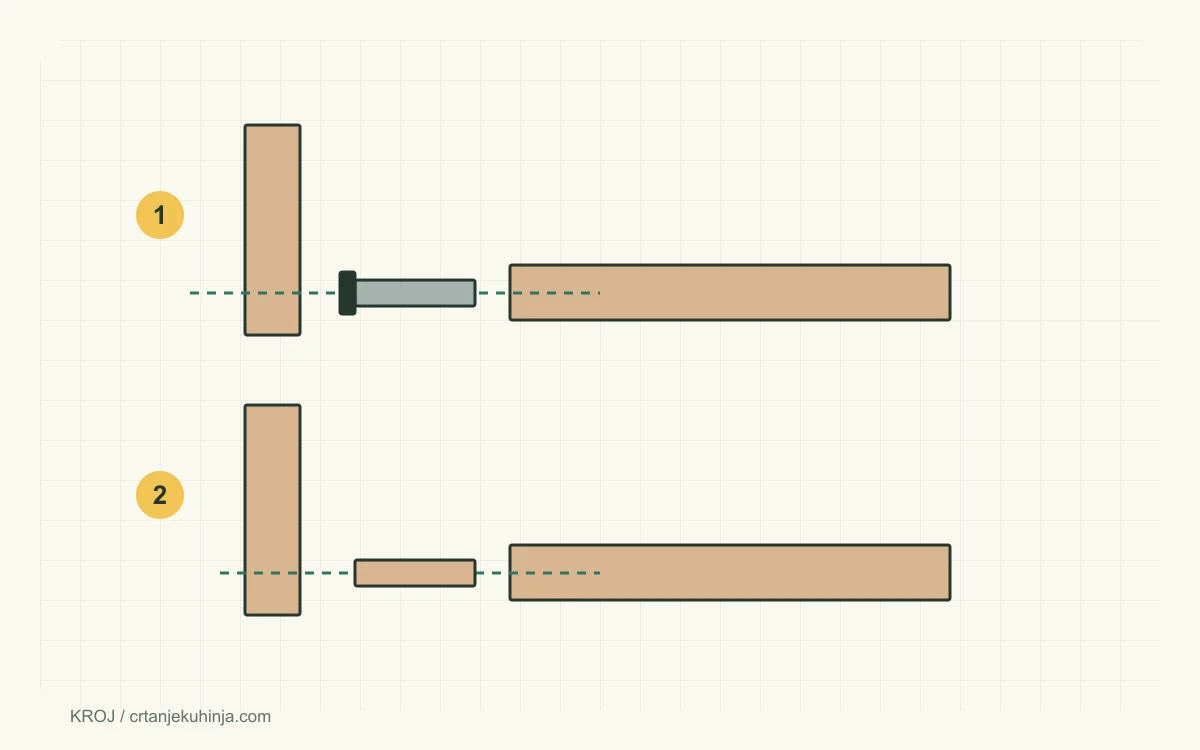
In a combined joint, wooden dowels help locate the panels while Confirmat screws clamp the connection. This can make cabinet assembly repeatable, but the drilling in both panels must match. Adding dowels cannot correct holes on different centres.
This guide concerns a side-to-bottom or side-to-rail joint within one cabinet. Joining adjacent cabinets through their sides and fixing a wall cabinet to a wall are different connections with their own fasteners. A wooden locating dowel is not a wall anchor.
Define the joint before drilling
Mark the outside face, front edge and matching panel pair on the drawing. Check actual board thickness and which finished edge is the drilling reference. Where the bottom fits between the sides, the hole through the side must align with the specified hole in the bottom edge. The centre of a board actually measuring 18 mm is 9 mm; this does not justify guessing the other spacings.
Coordinate screws and dowels with hinge and runner holes, shelves, back grooves and Gola machining. Do not copy an unchanged pattern to a notched panel or a different assembly direction. See CNC cutting and drilling for kitchen cabinets.
Match the screw and drilling system
Choose the screw and drill from their technical specification. The pilot hole in the receiving panel, clearance hole through the other panel and head recess have different functions. Häfele shows different stepped drills for its Confirmat joints, illustrating why one unspecified drill is not a universal solution.
Use a depth stop and check the recess on a sample of the same board. A shallow pilot can stop the screw before the joint closes; an excessive head recess damages the surface layer. Check the actual thread engagement in the receiving panel for the selected screw.
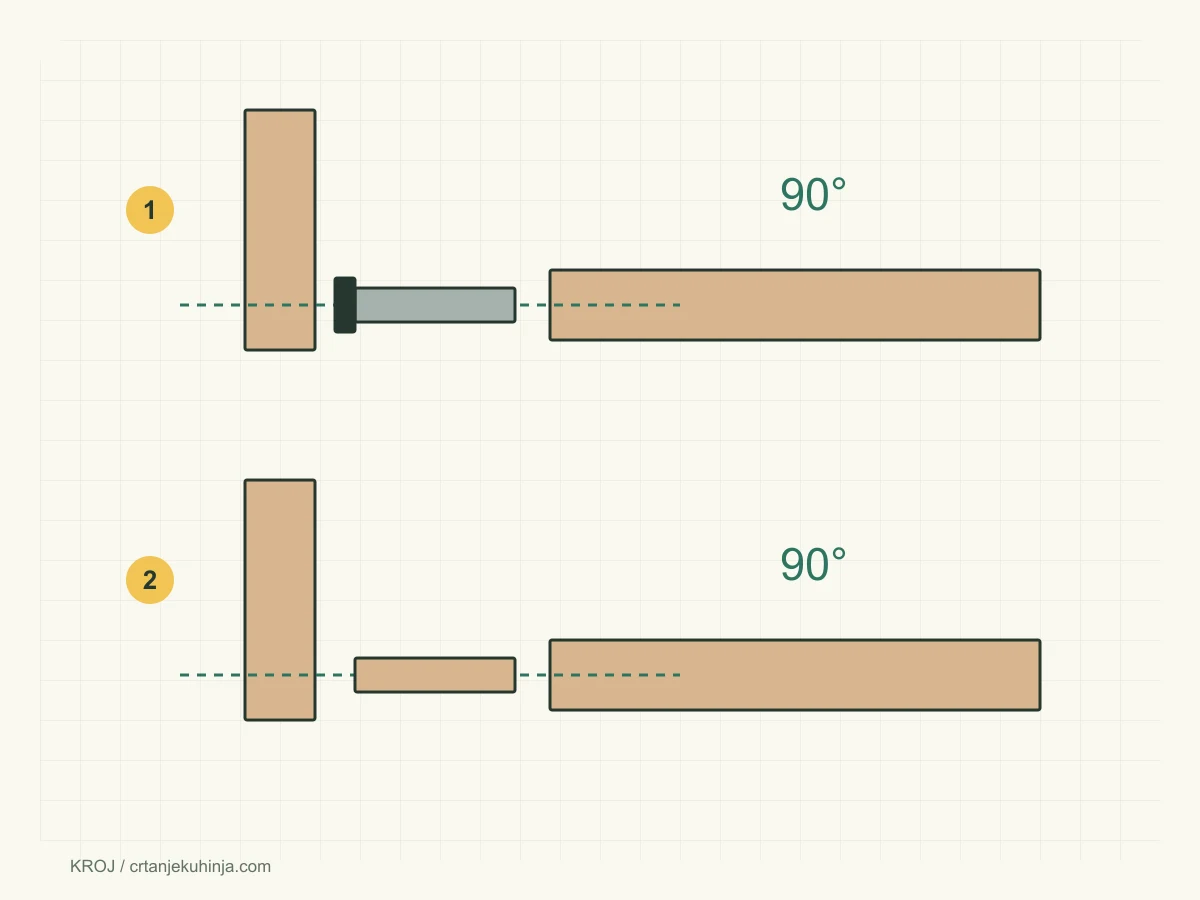
Two sections through the joint: 1 Confirmat through the side into the bottom edge; 2 wooden dowel in its own matching holes. Determine spacings, diameters and depths from the selected components, not this illustration.
Dry-fit the dowels first
Match dowel diameter and length to the hole depths in both panels. Allow the specified clearance at the bottom of the holes. A dowel must not hold the panels apart because it exceeds the available combined depth. Remove chips and check that the joint closes without damaging force.
Assemble without glue and check aligned edges and cabinet diagonals. If it does not close, take it apart and identify the cause. Hammering or overtightening can conceal the error until an edge breaks or the cabinet distorts.
Follow a controlled tightening sequence
Where a glued joint is specified, select adhesive for the material and service conditions and apply it according to its instructions. Excess glue in a blind hole can prevent seating. Prepare clamps, tools and the assembly sequence before applying it because open time is limited.
Align and clamp the panels with protective pads. Start the Confirmat screws, then tighten progressively while checking that the joint closes. Use a low, controlled final torque; impact driving can damage the thread formed in chipboard. Check the diagonals and install the back as designed. A back can help maintain squareness where its connection is intended to provide that function.
Benefits and limitations
- Dowels improve repeatable location; the additional holes require more accurate preparation.
- Confirmat screws provide clamping with accessible tools; the head remains visible or needs a cap.
- Dry dowels and screws can allow dismantling while the holes remain sound; repeated removal can weaken chipboard engagement.
- Glued dowels make clean dismantling difficult. Plan for narrow stairs and any site assembly requirements.
- More fasteners do not automatically mean a stronger joint. Closely spaced holes, weak board and unsuitable load direction can reduce performance.
A neat screw cap is not evidence of load capacity. A wall cabinet also requires a suitable cabinet construction, hangers, rail, wall fixings and supporting wall. Production documentation should identify the intended panel connections before drilling starts.
Related installation advice
Continue with Kitchen cabinet quality: what to check and Corner kitchen installation: joining cabinet runs.
Frequently asked questions
Must wooden dowels be glued?
Only where the joint is designed that way. A dry dowel can locate panels; gluing changes both assembly and dismantling.
Do Confirmat screws remove the need to check diagonals?
No. Check geometry before and after final tightening and back installation. A screw can secure a misaligned cabinet.
Should I use the same screws to join neighbouring cabinets?
Do not assume so. A joint through two adjacent sides needs a connector or screw suitable for that assembly and its combined thickness.