
Handleless
A handleless kitchen: how the gola profile changes front sizes
The gola profile shortens the front under the worktop by 30 mm, and every drawer joint takes 36. What exactly changes in sizes, banding and hardware.
A handleless kitchen is not made by simply leaving the handles off — the grip has to exist somewhere. In a gola system the grip is an aluminium profile RECESSED into the row of fronts, and it changes the sizes of everything around it.
Two profiles, two jobs
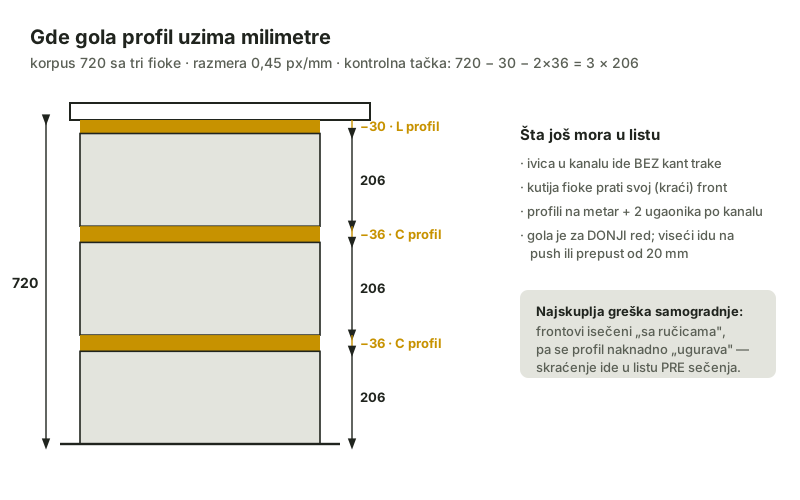
- The L profile (single-sided) runs under the worktop: the front below it is shortened by 30 mm.
- The C profile (double-sided) runs at every joint of two drawer rows and along the oven niche: every joint takes 36 mm.
On a 720 carcass with three drawers that means fronts of 206 mm each (720 − 30 − 2×36, split in three) — instead of the 236 that handled drawers carry. The drawer box follows its own front, so it is lower too.
What else has to be known
- The front edge that enters the profile channel goes without edge banding — the profile covers it.
- Profiles are sold by the metre and held by mounting brackets, two per channel; the price depends on the colour (anodised and powder-coated differ).
- Gola goes on the base row. Wall cabinets solve the grip differently: with push-to-open or with an overhang (the door passes the carcass bottom edge by 20 mm and is gripped from below).
- Tall units stay on push — vertical profiles are a separate world and a separate decision.
What it means for the price
Gola adds metres of profile and brackets, and removes handles; push and overhang remove both, but push adds ejectors. The planner calculates all three per cabinet — pick the system in the Look step and the estimate recalculates at once, with profile metres as their own line.
Frequently asked questions
Is a handleless kitchen harder to keep clean?
The profile channel above drawers collects crumbs — wiped in one pass, but wiped. Push fronts on wall cabinets take fingerprints more than a handle would — matt decors forgive that better than gloss.
Can I combine systems?
Yes, and it is the most common choice: gola below, push or overhang above. The upper row's system is chosen separately in the planner.
Where do I see how it looks?
The 3D view draws the profile channel at every spot that charges for it — the image and the estimate come from the same calculation, so they cannot disagree.